
My Dwindling, Infinite Mouth
1. Oh, dwindling mouth
All I want to do is talk about my tooth extraction.
“I had a tooth removed yesterday,” I inform my coworker. We’re at a holiday potluck, and I scan the spread—rice crackers, popcorn, carrots. I’m after more yielding foods. Deviled eggs, cubed melon, a cinnamon doughnut chewed slowly for the duration of a Secret Santa swap.
I work at a nonprofit founded by immigrants to serve immigrants, asylum seekers, and refugees, though in reality, we’ve expanded to serve anyone who walks through our doors. A boon to the entire community, the organization remains immigrant-led. I’m not an immigrant, or rather, a New Mainer, which is the most popular label. I suspect most people appreciate the terminology for its optimism and forward sense of community.
In one month, ICE will infiltrate our small, coastal city, but we already labor to talk about lighter things than men in masks carrying guns. I imagine it takes a large amount of effort for most of us.
“I can only eat soft foods,” I explain to another coworker. She sits beside me admiring the pretty silk scarf she’s just received.
“Bummer.” She gives my plate a vague but empathetic smile.
“No spicy food either,” I add. “My tooth was cracked side to side. It was way in the back, so I just had them remove it. You know, because you can’t see it and it was cheaper that way.” Though profoundly interesting to me, the comment doesn’t incite the enthusiasm necessary to sustain a conversation.
I excuse myself to the bathroom to stare. This is something I do now. My mouth, enclosed in the dark of my head, feels grotesquely enormous. Church-sized, holy proportions, but in the mirror, my gums, teeth, and tongue shrink to normal-sized. Tiny! I open and lean close. Every time, a flashbulb shock. Oh, dwindling mouth. Oh, fragile scoop of teeth and tongue. Is this all I’ve got?
I return to the table and my gently celebrating coworkers. I want to chuck my mistletoe mug against the floor.
My tooth is gone! Forever! Now, there’s just a hole! But the conversation has turned, rather enthusiastically, to scrapbooking, and I don’t want to compete with that.
2. The infinite mouth goes on
Three and a half weeks before ICE arrived en masse—enhanced with tinted SUVs, storm cloud breath, holstered, violent power—I researched mouths. Did you know the average human tongue is two and a half inches wide? That’s around the width of a U.S. dollar bill, spanning the gum-to-gum chasm with ten thousand taste buds, each bud a collection of around a hundred cells arranged in a manner poetically described by the Cleveland Clinic as resembling “a peeled orange or rosebud.”
There’s more; Among the hundreds of thousands of taste bud cells, Basel Stem Cells chug out even more taste receptor cells, producing fresh-peeled oranges, on average, every ten days. The mind boggles to conceive the imploding abundance. Like splicing, concaving themselves toward infinity. The mouth in my head feels infinite with renewal and inversing scale, but when I open wide, that infinity vanishes. The mouth in my head might feel infinite, but the mouth in my skull does not.
Most of the adults we serve arrive as New Mainers in need of English lessons. Many speak multiple languages: French, Lingala, Portuguese, Arabic, Spanish. I imagine their whoosh of thoughts swooping by a paucity of English containers. Thank you. Yes. Thank you. How are you?
Now that ICE has come up close, I wonder different things about language. For example, when is a New Mainer no longer new? Further, when would an immigrant no longer be considered an immigrant? Of course, the answer is never. You see, the containers don’t quite hold the same thought.
3. I love your Mouth! Come back!
“Try to feel your mouth,” I instruct my sixteen-year-old. We’re sitting alone at the dinner table eating tacos. “Doesn’t it feel enormous? Sure, you’ve got these other senses. Like, you can feel your arms on the table. You can smell dinner. Hear my voice…” His chewing slows. “But your mouth, when you focus on it, doesn’t it take up your whole head? Or even, especially if you’re tasting or talking, doesn’t it take up everything? Like the whole room?”
“Mom, what are you on about? Are you still complaining about your extraction?”
“It’s only been six days.” This is a rare dinner alone with him. I’m trying to drop truths. “If you look in your mouth, it’s surprisingly small. It’s crazy how few teeth we actually have. Like, after getting my tooth pulled, I only have four teeth on this one side. Not counting the teeth across the front, of course.” I open and point. His chewing picks up pace. “Think about it. Our mouths do so much. We speak, eat, breathe, kiss…” He’s speed-running his taco, standing before swallowing the last bite. “Wait! This is about death!” I say, absurdly, an attempt to score his attention.
He pauses before leaving. “Mom, you sound like a cartoon.” I’m not sure what he means, but I give him the benefit of the doubt and smile. “It’s okay, Mom. You just lost a tooth. Unfortunately, that’s a boring concept for most kids.”
“But it’s different. Nothing’s growing back,” I call as he exits, but he walks swiftly, without looking back, in a hurry to escape to friends online. Rewind: I recall the smooth cobble of tooth in my hand, the press of his head, as I wormed my fingers beneath his pillow. Back then, his head was plentiful with teeth that fell like bright raindrops. I sprinkled glitter, and the sparks scattered, a wonder we complained about weeks later for its persistent invasiveness and reach.
4. They are separate from me
Eight days after the tooth extraction, around three weeks before ICE arrives, I attend a wellness training on how to de-stress. Our instructor, who is a white woman like me, claims we hold significant trauma in our tongues. I jot the note with five exclamation points.
“If a person trauma-dumps on you,” our trainer advises, “repeat to yourself: this person is releasing their stress. Their stress isn’t my stress. They are separate from me.”
They are separate from me, I think each separate word, a separate container, a sentence I can say out loud.
They are separate from me. Hold the containers to the light.
Even with all those unfurling roses, eighty to ninety percent of taste is smell. And expectation. A mouth consuming a room. How do you separate the mouth without the language to point?
They are separate from me can mean one thing in one’s head and another in the mirror. Open up and see the grotesque gap of identity and privilege.
5. You win and lose and lose
My tooth was cracked from left to right. A yellowing barnacle. A small cavity eroded its center.
“You could put a crown on it, but that would be expensive and would most likely give you trouble down the road.” My dentist smelled like minty antiseptic as she wended her way around my chair and removed her gloves. “And it’s tucked in the back, so you won’t see the gap. It shouldn’t affect you that much.”
“Whatever’s easy!” I was dismissive waves and shruggy shoulders. “Sounds good to me.”
Consistently, I put off scheduling the extraction, a can kicked across a year. It was fine so long as I chewed on the right side of my skull, though my forgetfulness would bulldoze me, Flat Stanely me with pain.
My sister encouraged me over the phone. “The procedure isn’t painful. You just feel a lot of pressure. You’ll be fine.”
Still, I delayed, an avoidance, I suppose, of my disgraceful urge to spend an extra five hundred dollars for general anesthesia to knock me out. I didn’t want to feel pressure.
I once scotch-taped Henry Miller’s quote to my wall: “Don’t look away. Look straight at everything. Look it all in the eye, good and bad.”
Now, I’m a person who half-chews through a year to avoid acknowledging my willingness to pay half a thousand dollars to avoid knowing a broken tooth is leaving my mouth. I can’t help but wonder what other thoughts I half-chew to avoid.
Even here, in this essay, I look at myself looking at my mouth.
Of course, I take action. I join ICE verifier chats. I call representatives. I do my best to show up and ask what needs to be done. But I also look at myself watching videos of a stranger’s suffering, concaving into infinity before I close my laptop and find a recipe for dinner. In the end, my mouth healed relatively quickly. I haven’t looked inside my mouth for weeks.
6. I’m not sure if it’s supposed to hurt like this
I don’t want to feel everything anymore, and I have the gross privilege of turning certain things off. No one’s a hero for feeling, despite what some iteration of me used to believe. I imagine my New Mainer friends don’t want to feel everything, either. No one does.
And maybe the big feelings are a bit of a privilege, too. Stuck in the mirror yawping my mouth, infinite, dwindling, same, separate. We are built to compartmentalize, and it feels distinctly White, distinctly privileged to long linger in infinite shock, to decry pain because the pain hurts.
I recently attended a work webinar led by an immigration lawyer offering straightforward advice. “It’s your right. Unless they have a warrant signed by a judge, don’t open the door.” She speaks clearly, frankly. “Not even a crack.”
Next, a de-escalation expert stands small on my screen. Gently, she prompts attendees to unmute themselves. “When they tell you to go back to your country, when they demand, ‘Where are you from?’, hold your hands like this—” Palms point downward at her waist. “I want you to repeat, ‘Please, leave me alone.’”
The attendees repeat her words. I hear weariness. Concentration.
“If they don’t listen,” she says, “then drop the please. Repeat, ‘Leave me alone.’”
“Leave me alone.” Clunky mics; voices overlap. “Leave me alone.” Different accents. “Please, leave me alone.” Syncopated. Tired.
Normally, my mouth sits inside my head, a vacuous lobby. This way to my stomach. This way to the world. “Leave me alone,” I repeat, but I don’t unmute because I am weeping, and I share this to self-accuse, because after crying, I close my laptop, and there’s no one at my door.
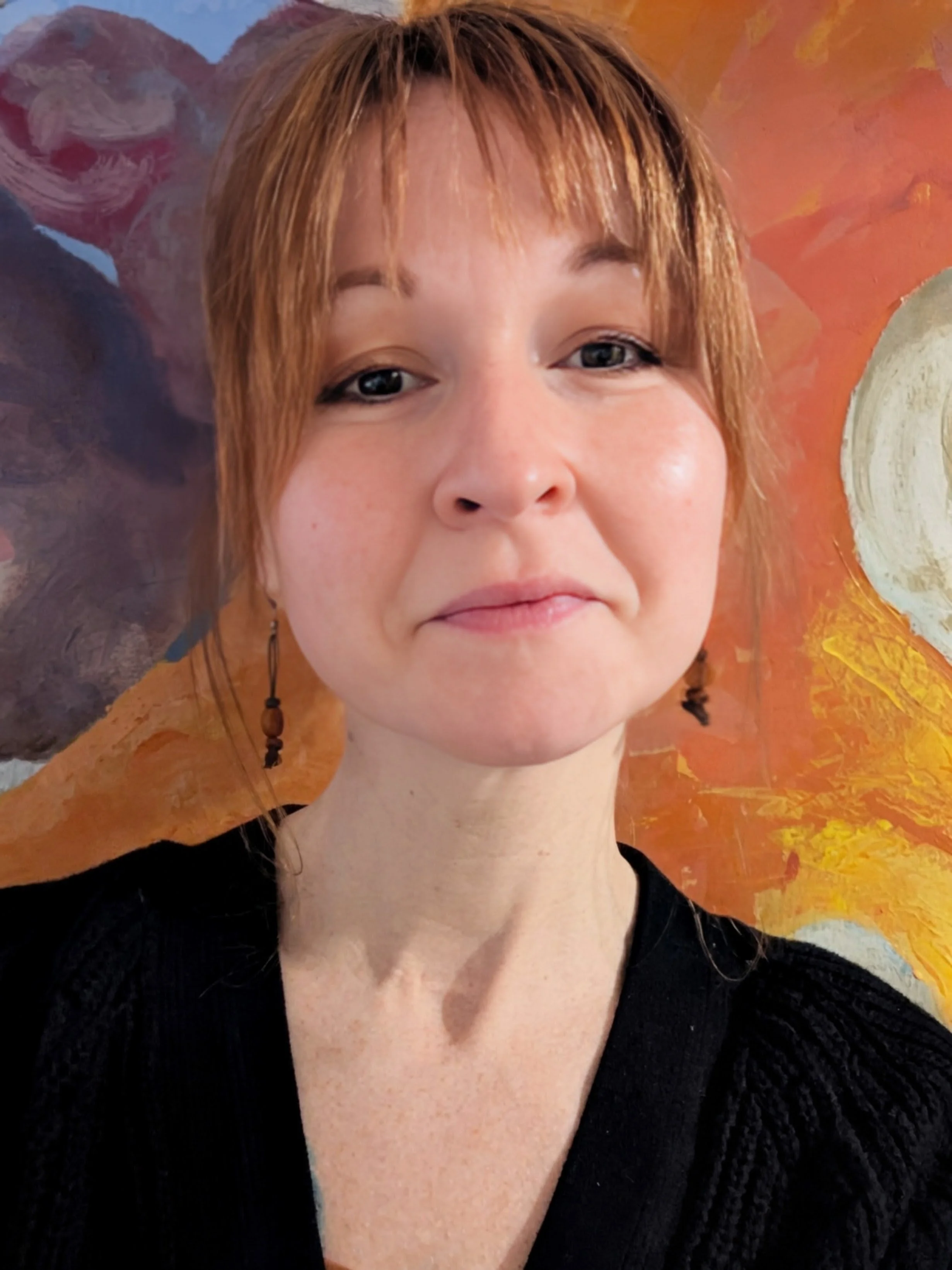
Elisha Emerson’s multi-genre writing has been published by The Missouri Review, The Dalhousie Review, Solstice Literary Magazine, The Masters Review, Wallstrait, New Square, and elsewhere. She is the recipient of the Solstice 2022 Nonfiction Contest prize and has been nominated for Best of the Net and two Pushcart Prizes (one in fiction, one in nonfiction). Her novel Currency was shortlisted for YesYes Books’ 2025 Open Reading Period. She holds an MFA in fiction from the University of Southern Maine’s Stonecoast Program and is a Senior Reader for Ploughshares.