
the second skin of stones
With my pole held out above the waterline, I inched a cautious step, anchoring my toes to feel the outline of rock in silt through the bottom of my shoe, assuring my footing before straightening to cast. Nearly hip-deep now, the rush against my thighs had become a pressure I pushed against as I eased myself forward through the center of the creek. I was walking into the shine of a midsummer sky almost too dazzling to raise eyes to, brilliant yet swollen with impending rain, a low ceiling pressing me down.
I cupped a hand at forehead and squinted hard, placing Glenn’s position upstream. The reflection off the water was dizzying—for a moment it looked as if we were hanging by our feet from the clouds—and I blinked rapidly to find focus. He was mid-throw, the movement traveling from the cut-off sleeve at his shoulder down the casting rod, the line floating, suspended, then jerked with a flick of wrist, landing in a shadowed pool at the seat of a gnarled sycamore. Its roots held hungry fistfuls of thick mud, the hollow in its trunk broad enough to shelter in. I turned my gaze from the blinding brightness, but in my mind, still saw the quick skip across the surface, his fingers balanced on the reel, the turn rhythmic and slow.
The river has always felt like some ambivalent, dual-faced god, and standing waist deep in rushing water is a peculiar thing—it’s so easy to mistake the tug of a passing branch as something dark and lurking, to identify your own smallness inside the vastness of nature. To feel as if a hand is reaching for you, beckoning, and the water’s natal lull a pied piper, together luring you to some surrender to depths unknown.
Tucking my own rig up under my armpit, I reached for the compact, plastic container at my hip and extracted one of the crawdads we’d hunted in shallows that morning. With thumb and forefinger, I pinched its dusky grey-blue body at the base of its tail, then pierced my hook through. It writhed against the assault, twisting towards me, curling for leverage; its claw an angry mouth snapped in protest, as if demanding to know who sanctioned this. I’d been fishing all my life, but still I felt regret for this casual cruelty before pole became an extension of will as I sent the bait to the edge of a log, half-submerged, hoping a bass would be biding beneath.
Fishing is the perfect pastime for introverts that still want friends. The afternoon passed as Glenn and I made our way up the river, while enough cloud cover moved in to soften the light. Tired and numb-legged, we signaled and began to make our way to one another across a rise in the middle where the water was low and had surfaced an oblong island of gravel the size of a small dock. It was there among a glistening, muted rainbow of pebbles that we found the ribcage: a sacrament offered on a table of stones. The bones were clean yet weathered, pocked and pitted as coral in places while smooth as pearl in others, buffed with creek sand and bleached over time.
Glenn had grown up in rural Pennsylvania, and though I was from Detroit, like many from Michigan, my summers were spent Up North. Neither of us were unfamiliar with the outdoors, and so neither of us could reason away what we saw. This didn’t appear to be any sort of wild game, nor livestock that wandered away.
“Shit. Looks human,” Glenn said, a tension cresting to a taut line.
I let out a short breath. “Likely,” I replied.
We took pictures with the waterproof camera, then discussed with low voices the compact chest, shaped like a plucked poplar leaf. Taking a knee, he outlined what appeared to be some jagged notches where perhaps a cut was made or beast had gnawed. It was hard to move in wet clothes out of the water, even as they dried against my skin, making everything feel too tight. The humidity settled like a second skin that could not be shed. I squatted beside him, then steadied myself. A few droplets struck me, and I was unsure of whether they were spray from the adjacent flow or coming from above. I hoped the rains would delay just a bit longer.
We decided to mark the spot and head straight up and out of the woods, to step through the timelessness of trees to the road. Some small thing had cleaved inside me, and I felt a strange sorrow leaving whoever this had been alone. It took us an hour walking fast to backtrack to where we’d parked near the spot where we’d entered the water, and another two hours of travelling from one station to the next, determining whose jurisdiction it was, since we couldn’t exactly say what county we’d been in while creek walking. Nobody was eager to claim a body. Finally, a Sheriff and coroner followed us back, and in half-lit dusk now, descending down the steep embankment, we took them to the bones.
These weren’t young men. I watched them leaning back to counter their footfall downhill, wondering how many years they might have until they, too, were worn away and absorbed. With flashlights they inspected the area, then began to survey and take notes. They told us they needed our disposable fishing camera. Again, they asked us to tell them how we’d come upon it, reasoning there are dozens of old farms in this area, and the land has changed over time. Sometimes old graves are washed away, this could be more than a century old …
Listening to their drawling voices, I could suddenly imagine their Maglites as torches, glowing in some former version of this space, a life lived in some other time. A beloved wife lost, or an invisible one discarded? And this part of Ohio had been an integral part of the Underground Railroad—might it have been a brave soul fleeing, only to die free under a shroud of stars? Or did this person last grace some late 80s milk carton? Would we ever know?
They took our addresses and personal information. We requested that they contact us, let us know how things panned out. Sometimes, we’re not permitted to… it just depends whether or not the details become part of an ongoing investigation…
When we were free to go, we again went up to the road, then drove until we had a signal. I called my future husband, Erich. Glenn and I found something, we’re headed home …
Over the next few days, we watched the papers, but saw nothing. We each kept fishing and swimming and hiking, worshipping our youth while moving alongside waters and trees, trying to merge into some sacred thing larger than ourselves. A few weeks later, we all met up at a local spot to shoot some pool. Glenn approached, plopping a sealed envelope on the bar.
“What’s this?” I asked.
“Our fishing pictures.” He shrugged, raising an eyebrow.
We took out the stack and began to sort through them, enlargements we didn’t ask for from the disposable camera. There were photos of catfish and random shots of the landscape, but the many angles we’d snapped of that half-birdcage of bones were gone. An oversight? Maybe. We were left to only guess what the sycamore knows.
The river remembers. Itself a Janus—its very essence contranym. It exists as doorway, as passage, as transition. Running between ribs, enfolding every angle. It is both under and over—the bridge and the thing to be crossed. And in its waters, an acquiescence. Perhaps that carries quiet comfort. Perhaps it is enough. How many secrets become the second skin of stones?
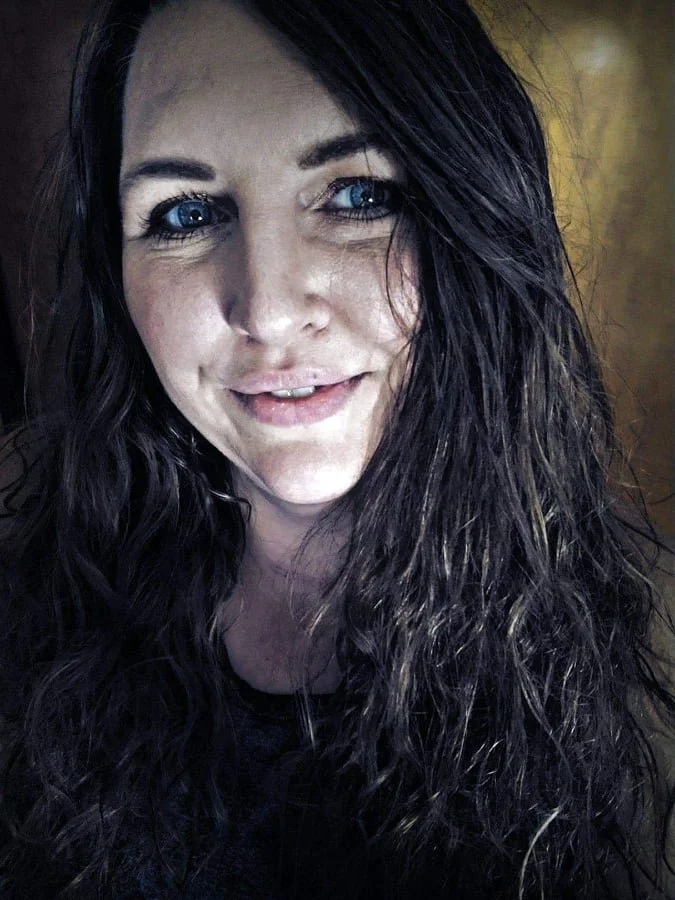
Heather Latham Miller is an emerging writer living in southwest Ohio. She earned her BA from the University of Toledo and recently returned to writing after decades devoted to raising a family. Her work has been recognized by the Toledo City Paper Fiction & Poetry Contest, the Dayton Metro Library Poetry Contest (in four separate years), and American Mensa’s PRP Award for Outstanding Poem. Her poetry also appears in the 2025 issue of Flights. Her piece “the second skin of stones” is her first published work of creative nonfiction.