
Bear Follows
When my grandfather was sixteen, he killed a bear. The hunt was a premeditated act. “Need some help with a bear,” the Game Warden told my grandfather the night before. “Keeps raiding the ranger station dump. Do it myself, but I raised an orphan cub once. That’s another story. I talked to your dad. He says OK.”
Badge pinned to his loaner uniform, the Warden drove my grandfather up the Kootenai River, air thick with pine tang and mock orange. At sixteen, he was on the verge of manhood, one foot across the threshold. He nodded as the Warden spoke. “Gotta make tough calls, sometimes. I seen what happens when you don’t. Could be more than a nuisance. Could become a danger.”
Dusk softening the ponderosas, the chokecherry and snowberry thickets on the lip of the hill, they parked and scanned the garbage mounds below: eggshells, beer bottles, ripped tires, rancid steaks. “Skin ‘em, they look human,” the Warden said. “But don’t kid yourself. They can break twenty miles an hour uphill.” Late summer, my grandfather had sweated through his uniform. Crickets bowed their dissonant drone.
It’s not like he’d never fired a rifle before. He’d shot marmots in paintbrush meadows and grouse off pine limbs. He’d hooked more trout up Pipe Creek than anyone at Libby High, he was sure. While his own father had killed bears, one point-blank on a cabin porch, my grandfather had never done it himself. This was his chance. A rite.
On his stomach, face to needle duff, he knew to suck a breath in before firing. Knew it would steady his trembles. “Comes out about now,” the Warden said quietly, as if to himself. “Maybe a deer kill will keep him away.” My grandfather shuffled, took a breath.
On cue, a chokecherry doubled down and dove. Near the end of his life, he would describe that bear in a poem as a “ghost of a shadow,” materializing “from the dark closet of timber.” He would remember its glossy sheen. Its forward motion like mercury, rolling out of the thicket. The swivel of its head, nostrils quivering, before rising on its hind legs. The gaze.
When the Warden belted, “Now!” my grandfather squeezed the trigger. The bear recoiled, tumbling over itself. Instantly, it barreled to its feet and charged. From thirty yards, my grandfather saw red foam spewing from its lips, heard grunts as it ran. Heard the Warden yelling unintelligibly, now hidden behind the car. He squeezed again. Just shy of the crest, the black bear paused, lurched. Its legs crumpled. The eyes glazed.
*
I live with this like a birthmark, a sliver driven into skin. It comes to me unwittingly, our inheritance of bear. In dreams, I crossed clearcuts, bleached rows of logs, nosing half-blind towards treelines and away from the hunters, the boys with guns. I was always running. Like a line from my grandfather’s poem, “something sensed rather than seen” tracked me across those psychic landscapes. Not certain what the hunters might do once they snared me, what they might make of my skin, running became my refuge. As long as I never quit, I couldn’t be caught.
In one dream, my flight ended on a bluff, overlooking a wide, unpeopled territory: countless estuaries, beaches littered with sea-peeled trunks and root wads. Down there, among the tight groves of alders, nobody would find me. They’d never dare to trek down from this hill. I would be home, or at least free to make habitat out of this coastline, far from the paradigm of hunter and hunted. Without looking over my shoulder, I took one step and hooked my foot on a branch, sending me rolling downhill, out of control.
In another, I wore knight’s armor and rode a horse alongside the other animals—bears, sheep, elk, moose—blitzing madly out of the woods. Driven by wildfire or bulldozers, nobody attacked; we were united in our fleeing. I kept my gaze trained on the horizon, the other animals beginning to vanish in my periphery, one by one. It was too late; neither the horse nor I noticed the lip of the cliff we’d been galloping towards. As we launched and fell together, down to a far green gorge, my armor sloughed off like a husk, steel pieces splitting free. Suddenly light, almost lofting, they spun like leaves.
*
I knew my grandfather only as a child could: a Stetson-donned, sweet-talking man who made us watch the Stooges, made fudge, and regaled us with wilderness tales from his youth. Around the family, he was an entertainer, an orator, a storyteller, and a comic. It was my uncle, years after my grandfather’s death, who told me at a Thanksgiving party about the bear’s return in my grandfather’s dreams.
“You hadn’t heard this?” My uncle asked. “Holy smokes.”
I hadn’t. My grandfather left us with a hard drive of poem drafts that I’d read in depth, studied to gain a pulse on who he was beyond the myths of frontiersman and bard.
“Great Bear Follows” details my grandfather’s shooting of the black bear, including three quatrains of present-tense narration of a nightmare. I knew it well, but never sensed the weight my uncle would describe.
“He had these dreams forever,” my uncle explained. “At least a couple times a year. He’d be walking alone down a forest road when he’d get this hunch. I’m being followed. Just a sixth sense sort of thing, you know? Something would be flanking him through the brush, inching closer and closer. So he’d run. And the thing ran, too, crashing out of the woods. He couldn’t see it, wouldn’t dare look back, but knew it was that black bear, the one he’d shot, right on his heels. He’d come around a bend and see an old ranger’s cabin. Just as he leapt up to the porch and put his hand on the knob, he’d wake.
“It happened like that, over and over. Except in the next dream, he’d be inside the main room, that bear right behind him. He’d run down a hallway, reach for another door, and wake up. His whole life, that bear kept chasing him through this empty cabin.
“Around 1990, I think, he had to have his prostate removed. After they put him under, he said he woke up on the surgeon’s table, paralyzed. He couldn’t move anything but his eyes. The operating room was fully lit and empty. Then he heard this sound, totally unmistakable: heavy paws down the hallway, slowly plodding. The doors parted, and he saw it again, that same bear he’d killed as a teenager. And he was stuck, frozen to the table. The bear pawed its way up to him, nodding its big head until they were eye to eye. Then it turned, lowered its chin onto his chest, closed its eyes, and slept.”
*
My grandfather’s headstone held the north range of the Cabinet Mountains in its reflection, held an ash tree’s clustered berries like salmon roe. This was my seasonal pilgrimage; each time I walked the municipal road, up through the Fireman’s Campground, under the telephone line that led to his marker, I felt the world’s noise thin out and settle. Crows croaked in the cottonwoods on Flower Creek. The squeal and mutter of the supermarket’s rooftop fans merged with the flowing water.
Occasional cars traced through the cemetery, seemingly silent, as if they rolled with engines off.
I had knelt to leave my grandfather gifts: black licorice sent from my mother, and an elk hair caddisfly, hand-tied at a picnic table, with the afterlife’s rivers in mind. That day, I had driven from Missoula, only a four-hour trek. Often, I’d arrive in Libby after overnight train rides across the desert, journeys I’d never sleep through, stuck watching the Earth turn from the plateau’s formlessness to familiar shapes of rising mountains: a raven against a pewter sky, feathered cedar’s silhouettes, and bluffs of the Kootenai gorge, buckling with lift.
It was never clear if my grandfather sensed my persistence in visiting. Though I felt I had almost tracked him down, heard his disc-jockey voice in Flower Creek or the bowing strum of a train’s rails, I never denied that this pilgrimage was an internal one. Wanting to know my grandfather beyond the Stetson’s facade, I also wanted to know him beyond the wound of that hunt, to encounter him as more than a boy running from the violence handed down to him.
“I’m trying to find your bear,” I said. “Do you hear me? Please, just tell me where.”
Then I heard a voice, not in my ears but somewhere inside of me, less a person’s speech than the sounds of words themselves, like rockfall spurred by subtle wind:
Just look all around in a circle, OK?
*
The first bears I saw were always from a distance: black ones rising far chutes of huckleberry and tag alder. Cinnamon yearlings in desert willows and soapweed yucca. Sibling grizzlies cuffing one another, tumbling down grass slopes. Most every bear I’d seen had run away once it sensed me. Often, they were already fleeing, their hind quarters rolling with waves of fat and bristle. Wide leaves of devil’s club tossing at random once revealed a chocolate cub below, trying to nose its way to the safety of thickets, far from my scent. I watched it from my vantage in a creek bed below, tracking the rustle of leaves up the hill, occasionally glimpsing glossy fur through windows of green.
In another encounter on a brushy trail, approaching the sound of water, I came around a bend and saw a black bear sitting on its haunches in the middle of the creek. We could have touched each other if one of us had leaned in. I didn’t think to breathe deeply through my nostrils, to try and catch the mysterious scent of bears described by those who’d gotten close: a kind of woodland spice like cardamom or nutmeg. Instead, I gasped. The bear exploded, splashing as it bounded away. But it stopped fifty feet up the hill, turned, and began yelling. I didn’t need a translator to know that its cadence of whines and grunts was interrogative: Why had I been so quiet? Why was my scent so hard to catch, down there? Who did I think I was? After barking, the bear shuffled off into the pines. I stood where it sat cooling off, wondering if I should have apologized.
None of these was the bear of grandfather’s dreams, the one that plodded its way into our blood. A bear seen was always a cause for celebration, but nothing more. I had gone in search of a ghost, following slough-paths through dense brush, sleeping where bears sleep, but had not found it. My grandfather was gone, off into wilder corners. He would call my father in dreams, asking him where the fishing tackle went, the line always fizzing with static. Perhaps his bear followed him out there. Perhaps they walked together—my grandfather up his creek, the bear in the mock orange along the shore—not hunting, not chasing, perhaps not even as friends, but as a pair.
Halfway up another trail, lost in fireweed that swayed over my head, I set my backpack down to pause and listen. Nothing but the brushing stalks and drafts of the canyon. Maybe it was a smell I picked up but didn’t register, a pheromone, maybe another sense. But something was watching me, I felt, something I couldn’t see through the seedy tufts of fireweed or hear through the forest. Shouldering my pack, I paced back downhill, looking over my shoulder for the tawny flash of a cougar or the swaying bulk of a bear. Nothing, still.
At a creek crossing, out loud, I said, “Enough is enough.” I set my pack down again, unlaced my boots, and sat in the water. Late light slanted down through the cedars, their trunks wide as roads. Devil’s club bobbed in the breeze. “I just want to be a place, instead.” No more running. Just sit. Midges hovered in the creek’s channel. Little beads leapt off shining rocks. When I looked back up from the moving water, the cedars bent and swirled, leaning towards me as if they were malleable, like new bedrock, still forming. “Okay,” I said, standing up to tug on my boots. “Okay. I just want to see a bear. That’s all.”
When I turned around, not ten yards down the creek bed, there he was.
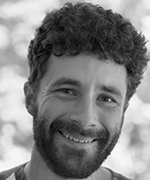
Raised in Portland, Oregon with family roots across Montana, Sam Olson calls both states home. He holds an MFA in Poetry from Oregon State University, where he currently teaches writing courses. Find more of his work at www.ourfeetonearth.com.